Welcome to my website! I'm a Research Data Manager at FAIR (Centre for Experimental Research on
Fairness, Inequality and Rationality) at the Norwegian School of Economics (NHH) in Bergen.
My research focuses on distributional preferences, team cohesion and organisational innovation, and I
build experimental tools for scientific research.
Previously, I was a postdoctoral researcher at the University of Zurich. I received my PhD
from CeDEx at the University of Nottingham.
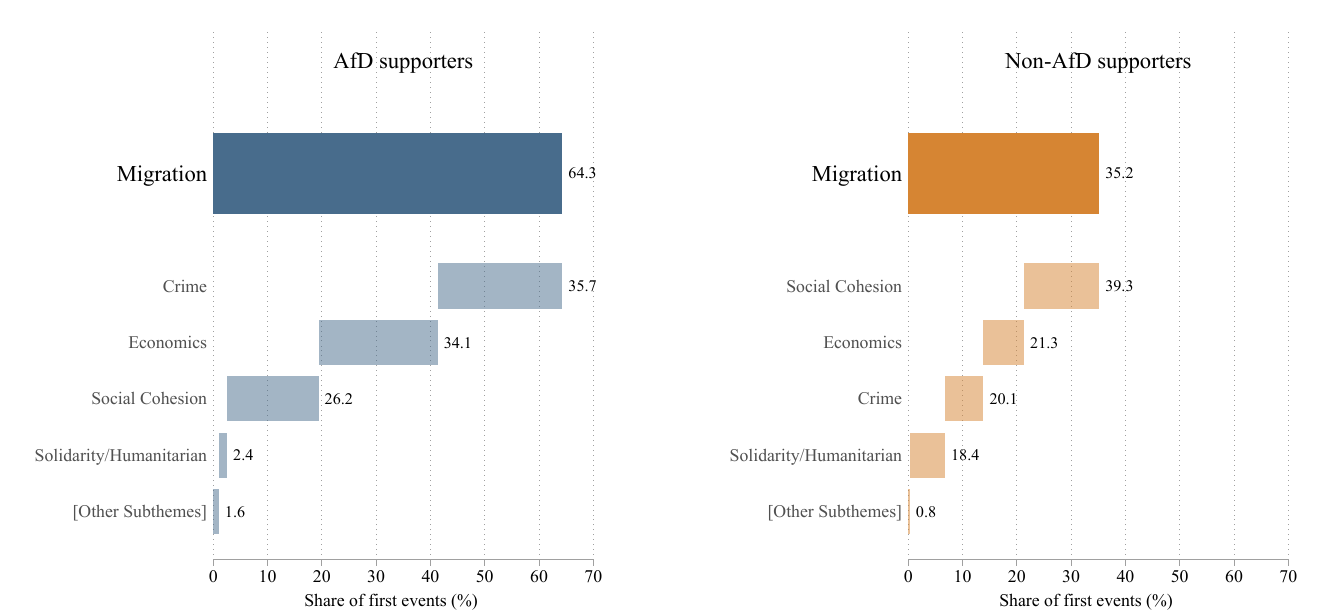
Share of AfD and non-AfD supporters who name a migration-related event first, and the narratives they attach to it.
In two studies using AI-assisted qualitative interviews, we ask a representative sample of the German electorate (N = 1,013) to reflect on the most important societal events of the last 15 years. We document that far-right supporters construct systematically different narratives about the recent past. First, they recall different events, with a strong focus on migration-related issues. Second, even when they do consider the same events, they are more likely to blame the establishment and describe events more negatively and with greater emotional intensity. We further document that these narratives are associated with policy preferences, and that far-right supporters are more inclined than supporters of other parties to prioritize cultural over economic issues. Together, our findings reveal that partisan divides extend to how citizens remember and interpret shared national experiences.
Try it: think of someone you know as X and move the slider until the circles show how close you are. Your answer: 6 / 11
The study of relationship closeness has a long history in psychology and is currently expanding across the social sciences, including economics. Estimating relationship closeness requires appropriate tools. Here, we introduce and test a tool for estimating relationship closeness: 'IOS11'. The IOS11 scale has an 11-point response scale and is a refinement of the widely used Inclusion-of-Other-in-the-Self scale. Our tool has three key features. First, the IOS11 scale is easy to understand and administer. Second, we provide a portable, interactive interface for the IOS11 scale, which can be used in lab and online studies. Third, and crucially, based on within-participant correlations of 751 individuals, we demonstrate strong validity of the IOS11 scale in terms of representing features of relationships captured by a range of more complex survey instruments. Based on these correlations we find that the IOS11 scale outperforms the IOS scale and performs as well as the related Oneness scale.
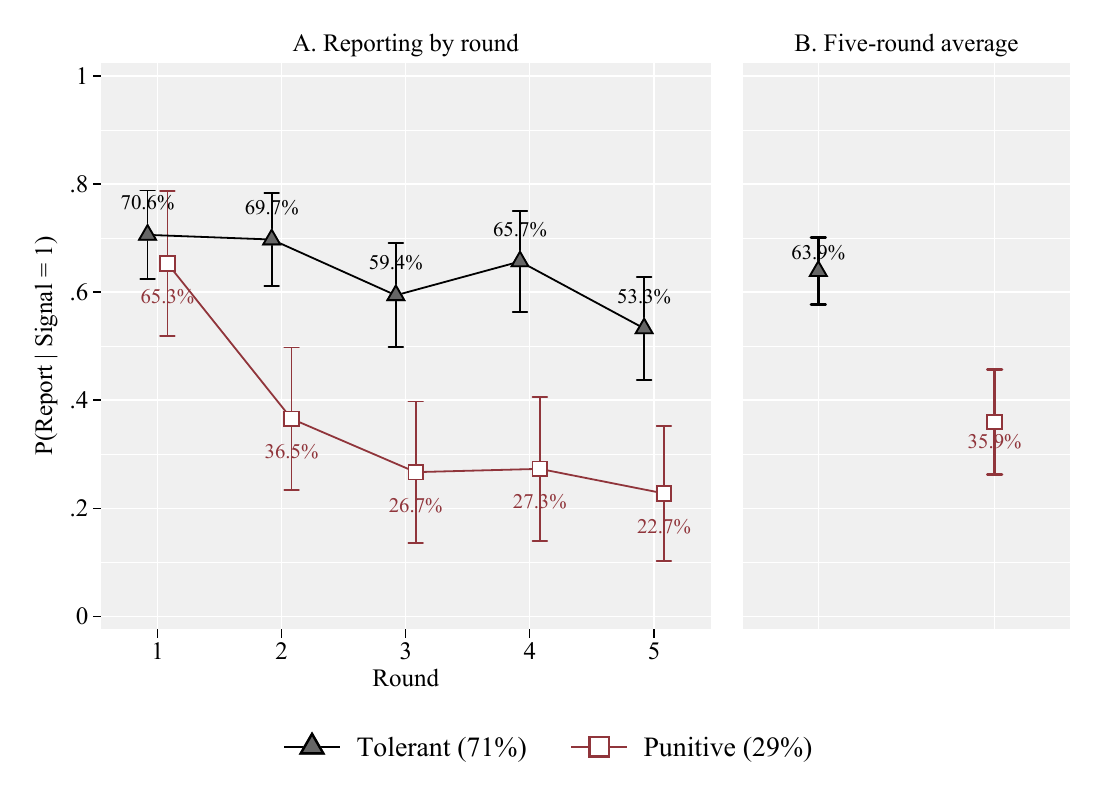
Probability of reporting a mistake by round, for participants facing tolerant versus punitive managers.
Even though reporting mistakes could substantially improve work processes and productivity within organisations, employees often hesitate to do so. This paper studies why employees stay silent and how some organisations manage to build successful reporting cultures while others do not. Drawing on a principal-agent framework with career concerns, we formalise mistakes as noisy signals of both agent quality and the work environment and show that optimal reporting decisions are affected by fear and futility considerations. We then use a novel pre-registered experiment (N = 1,020) to exogenously manipulate both barriers in a 2×2 between-subject design. Our results show that fear and futility have additive effects, both need to be addressed to generate a significant increase in reporting. In another pre-registered experiment (N = 504), we extend our setting to a dynamic environment, in which fixed groups interact repeatedly. We find that different reporting cultures in ex-ante identical groups arise due to the way principals respond to reports. Finally, we find that an intervention where principals can send a message signalling the value of honest communication increases reporting not through agents but instead by committing principals to more leniency.
We experimentally examine how incentives affect conditional cooperation (i.e., cooperating in response to cooperation and defecting in response to defection) in social dilemmas. In our first study, subjects play eight Sequential Prisoner’s Dilemma games with varying payoffs. We elicit second mover strategies and find that most second movers conditionally cooperate in some games and free ride in others. The rate of conditional cooperation is higher when the own gain from defecting is lower and when the loss imposed on the first mover by defecting is higher. This pattern is consistent with both social preference models and stochastic choice models. In a second study subjects play 64 social dilemma games, and we jointly estimate noise and social preference parameters at the individual level. Most of our subjects place significantly positive weight on others’ payoffs, supporting the underlying role of social preferences in conditional cooperation. Our results suggest that conditional cooperation is not a fixed trait but rather a symptom of the interaction between game incentives and underlying social preferences.
The study of relationship closeness has a long history in psychology and is currently expanding across the social sciences, including economics. Estimating relationship closeness requires appropriate tools. Here, we introduce and test a tool for estimating relationship closeness: 'IOS11'. The IOS11 scale has an 11-point response scale, is a refinement of the widely used Inclusion-of-Other-in-the-Self scale. Our tool has three key features. First, the IOS11 scale is easy to understand and administer. Second, we provide a portable, interactive interface for the IOS11 scale, which can be used in lab and online studies. Third, and crucially, based on within-participant correlations of 751 individuals, we demonstrate strong validity of the IOS11 scale in terms of representing features of relationships captured by a range of more complex survey instruments. Based on these correlations we find that the IOS11 scale outperforms the IOS scale and performs as well as the related Oneness scale.
In a within subjects design we evaluate distributional preferences and reasoning ability to explain choices in the Traveler's Dilemma. We recruit subjects from economics and non-economics majors to have a high variance of preferences and abilities. We find that economists follow the efficiency criterion while non-economists follow maximin. Economists also show a better reasoning ability. We, therefore, confirm the self-selection hypothesis of choosing a major. An equilibrium of an incomplete information version of the Traveler's Dilemma explains the behavior we observe. Subjects with low reasoning ability make choices away from equilibrium. Thus, (non)cooperative behavior might be misinterpreted if subjects’ reasoning ability is not taken into account.
Even though reporting mistakes could substantially improve work processes and productivity within organisations, employees often hesitate to do so. This paper studies why employees stay silent and how some organisations manage to build successful reporting cultures while others do not. Drawing on a principal-agent framework with career concerns, we formalise mistakes as noisy signals of both agent quality and the work environment and show that optimal reporting decisions are affected by fear and futility considerations. We then use a novel pre-registered experiment (N = 1,020) to exogenously manipulate both barriers in a 2×2 between-subject design. Our results show that fear and futility have additive effects, both need to be addressed to generate a significant increase in reporting. In another pre-registered experiment (N = 504), we extend our setting to a dynamic environment, in which fixed groups interact repeatedly. We find that different reporting cultures in ex-ante identical groups arise due to the way principals respond to reports. Finally, we find that an intervention where principals can send a message signalling the value of honest communication increases reporting not through agents but instead by committing principals to more leniency.
Unethical behavior, deception, and fraud are major concerns in corporate governance. This paper examines the effectiveness of contemplation questions (CQs) as decision aids for employees facing ethical dilemmas. CQs, such as “Will the reputation of our company be damaged if my decision is made public?” are intended to activate moral agency and prompt employees to consider their actions from various perspectives (e.g., self, peers, company). Through two pre-registered, incentivized vignette experiments, we systematically investigate the causal effect of CQs on ethical decision-making. In Study 1 (N = 1,986), merely presenting CQs had no impact on ethical decisions. In Study 2 (N = 1,322), increasing engagement with CQs led to marginally more ethical decisions among individuals with high moral identity but significantly fewer ethical decisions among those with low moral identity. These findings align with a conceptual framework of motivated moral reasoning and suggest that while CQs can positively affect some individuals, they also backfire, promoting unethical behavior precisely in those already predisposed to such tendencies.
Organizations are investing increasing effort and resources into supporting ethical decisionmaking among employees. One common approach involves the use of "contemplation questions" (CQs) - simple, reflective prompts designed to encourage thoughtful consideration of ethical challenges. In this study, we compile a unique dataset on CQ usage among the world's largest companies and find that at least 35% of Fortune Global 200 companies and 59% of S&P 200 companies employ CQs. An analysis of 727 CQs reveals significant variation across regions and industries. Based on an employee survey, we propose a classification of CQs according to the normative references they invoke, resulting in five categories: Law and Reputation, Company Policies and Culture, Universal Principles, Self, and Peers. We find that companies favor CQs focused on legal and organizational norms, whereas employees rate questions appealing to universal principles and personal values as more useful - indicating a potential mismatch between corporate practices and employee preferences and motivating future research on behavioral effectiveness.
In two studies using AI-assisted qualitative interviews, we ask a representative sample of the German electorate (N = 1,013) to reflect on the most important societal events of the last 15 years. We document that far-right supporters construct systematically different narratives about the recent past. First, they recall different events—with a strong focus on migration-related issues. Second, even when they do consider the same events, they are more likely to blame the establishment and describe events more negatively and with greater emotional intensity. We further document that these narratives are associated with policy preferences, and that far-right supporters are more inclined than supporters of other parties to prioritize cultural over economic issues. Together, our findings reveal that partisan divides extend to how citizens remember and interpret shared national experiences.
AI decision assistants are entering domains where moral judgments matter, yet their effects on ethical choices remain poorly understood. In a preregistered multi-wave experiment, participants faced repeated ethical dilemmas with or without an AI assistant that scaffolded reflection without recommending actions. AI assistance increased decision confidence (Cohen's d = 0.40) more strongly than it increased ethical choices (d = 0.21), creating a confidence trap. The pattern persisted when controlling for choice improvements (residualized d = 0.36), and deeper reflection predicted choices but not confidence, consistent with confidence responding to the procedure rather than its content. Effects were strongest among morally motivated participants. These findings indicate an AI governance risk: decision support may inflate users' confidence more reliably than it improves stated-choice quality, and evaluations should not treat user confidence as evidence of effectiveness.
Digital transformation creates opportunities for organizations but also raises ethical risks related to privacy, surveillance, discrimination, and data use. Corporate digital responsibility (CDR) emphasizes the need to support responsible decision-making when evaluating digital initiatives. One widely used approach involves checking questions that encourage ethical reflection, yet little is known about their effectiveness. Across two experimental studies with professionals involved in data-related activities, we examined two types of checking questions: Ought-Questions, which prompt comparisons with normative standards, and Is-Questions, which direct attention to project-specific ethical risks. Contrary to expectations, Ought-Questions did not reliably reduce the acceptability of ethically problematic digital projects and, under some conditions, produced a boomerang effect. These effects depended on participants’ recognition of normative discrepancies and ethical risks. In contrast, Is-Questions, alone or combined with Ought-Questions, consistently promoted more critical evaluations. The findings show that ethical decision aids can both support and undermine responsible judgments in digital contexts.
Identifying creative ability and its determinants is crucial in understanding artistic and innovative achievements. Previous work has shown that performance across established creativity tasks does not correlate within participants. A potential reason for this finding is that most creativity tasks lack well-defined performance criteria. In this paper, we develop a novel tool for measuring creative ability and assess its performance through experimental tests. We construct a semantic network serving as the underlying structure of our tool. Based on this network, participants perform two associative thinking tasks, Local Search and Depth Search. We characterise each task by relating it to an established measure of creativity, finding that performance in our proposed tasks is significantly related to their matched creativity task across several dimensions. Our new tool improves on established creativity tasks by utilising a predefined solution space. While capturing key features of established methodologies, it substantially increases on the ease of implementation and interpretation. In addition we also provide causal evidence on the effect of incentives on our tool.
In this paper, we develop Flexi-DPE, which estimates distributional preference parameters from as few as three decisions. Flexi-DPE builds on Fisman et al. (2007) who use 50 modified dictator games to estimate preference parameters of “fairmindedness” and “equity-efficiency”. Since eliciting 50 decisions is often not practical, we use simulations and pre-registered experiments to test the accuracy of preference parameters elicited from 20, 10, 5 and 3 modified dictator games compared to the 50-decision benchmark. Accuracy of parameter estimates of fairmindedness is only slightly reduced with few decisions; accuracy of parameter estimates for equity-efficiency suffers somewhat with few decisions. We also show that preferences elicited with Flexi-DPE are robust with and without incentives, stable over time, and unaffected by drastic shortening of instructions. Lastly, we find that all versions of Flexi-DPE predict actual charitable giving irrespective of the number of decisions. Our results provide a menu of options for researchers in terms of the trade-off between the accuracy of parameter estimates and the duration of elicitation.